There is a little action in the comments on Michael Geist’s blog that asks the question of whether Canada really needs its own anti-spam legislation.
In his article in the Toronto Star this week, Professor Geist charges that Canada has become a haven for spammers. But the Facebook suit against Montreal spammer appears to have been able to proceed successfully through the US courts.
Would Canadian legislation have been as effective, let alone achieve more success? Whenever existing laws are able to shut down video and software copyright violations, we are told this is evidence of why no new legislation is required.
So let me ask the question: Why does Canada need its own anti-spam law?
Don’t get me wrong. I am not in anyway condoning spam.
I just think Do Not Call List legislation demonstrates what can go wrong with technology specific laws. Why can’t existing fraud laws and civil suits be applied to criminal internet activities?
The Star article acknowledges that:
In light of its profit-making potential, no amount of antispam legislation will completely eliminate the problem.
Worst case will see us get it wrong and introduce costs on legitimate businesses while doing nothing to stem the flow of the real garbage filling our inboxes.
I don’t think I ever met anyone who was as passionate about this country as Ted Rogers. He loved Canada as much, if not more, than he loved the communications business. And all of us in the world of telecommunications have been touched by the influence of Ted’s communications empire, successfully bundling and converging broadcasting, cable TV distribution, wireline telecom, fixed and mobile wireless, together with so many content properties.
I first met Ted nearly 19 years ago, when I was part of the team that put together the business plan for competitive long distance under the Unitel banner. I had responsibility for the capital budget and faced an intense grilling from the board, led by zinger after zinger from Ted. That meeting was my first cross-examination; after that session, CRTC hearings were a breeze.
My favourite recollection was Ted coming to The 2007 Canadian Telecom Summit. As we gathered for lunch, we had the leadership of Canada’s industry together for a memorable moment. When he approached the registration desk, he was greeted by Susie, who was introduced to him as “Mark Goldberg’s wife.” Ted said “Mark Goldberg. Now there’s a great Canadian entrepreneur.”
I don’t hold a candle to Canada’s greatest entrepreneur. He will be missed.
Derek Slater and Tim Wu have released an interesting paper called Homes with Tails [pdf 206KB]. The paper examines consumers taking ownership of their connectivity to the network. Peter Nowak at CBC quoted me in an article about the concept.
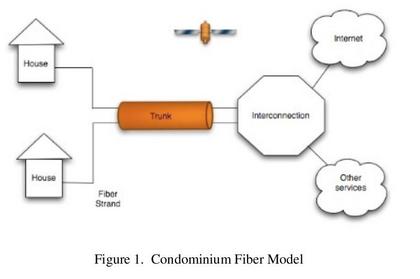
We call this property model “Homes with Tails,” for the fiber would form part of the property right in the home. Key facets of our approach include:
1. A “condominium” model for fiber ownership, in which individual strands of fiber are sold to consumers, while maintenance and other collective needs are managed jointly.
2. Private firms and municipalities could consider selling fiber connections based on this model; and
3. Governments could consider using various mechanisms to support consumer purchases, including a tax credit to homeowners or renters who purchase a broadband connection.
It is an early version of the paper and hopefully the authors will continue their thinking and development of the concepts. I’m left not convinced that we’ll see homes with tails outside niche community applications.
Here are some thoughts, in no particular order:
One of the reasons that traditional service providers have typically shunned delivery of their service over other people’s infrastructure has been the issue of trouble resolution. Consumers typically want one throat to choke and that neck usually belongs to the service provider – the folks charging the end user. If a third party manages the fibre access, how do all of the stakeholders most effectively work through the finger pointing? How much longer will the average repair take?
Speaking of repairs, the Ottawa experiment is described in the CBC story as having fibre hanging from street-side poles. Anyone who has experienced a winter in our nation’s capital will understand why major service providers are nervous about signing on to a project using aerial cable.
Will adding a third party access facility manager mean that a new participant is going to have their hand extended for a share of the profit? That means the homeowner is paying thousands of dollars up front for the fibre and a monthly ‘condo fee’ as well.
Do enough homeowners want to buy such a physical asset or do they prefer to pay for services? Do you rent your water heater or own it? Do you rent your set-top box or own it? What factors went into your decisions on these items? If you are a property renter, what are the implications of your landlord owning your “tail.”
It might be interesting to examine some of the overall economics associated with the creation of a virtual monopoly in fibre access. For example, what is the impact on a business arranging for a more survivable access architecture, if the condo group has pulled away most of the business case for building metro access facilities?
I found a quote in the CBC article interesting:
The retail internet business in Canada has been destroyed. All you’ve got left in Ontario is Bell and Rogers.
This statement is troubling, especially attributed to CANARIE, Canada’s advanced network organization. In fact, there are lots of retail alternatives operating throughout Ontario and the rest of Canada. They even have an association: The Canadian Association of Internet Providers (CAIP). In fact, when CAIP filed its CRTC application last April, it did so “on behalf of those of CAIP’s members that provide retail Internet access services,” so there should not be any confusion about retail alternatives. There are many others that are not members of CAIP, some of which co-locate and power leased copper loops.
If the concern is that the supply of facilities-based alternatives is too limited, why should we think we are better off with a monopoly condominium fibre manager?
Update [December 4, 1:40 pm] Derek Slater will be appearing at The 2009 Canadian Telecom Summit in June to talk about Building Broadband networks.
Canadians need to continue building a modern and reliable infrastructure. Investing in a 21st century infrastructure will create a competitive advantage that pulls business and jobs into a vibrant national economy and brings our skills and goods onto the world stage efficiently. It will also stimulate the economy and put people to work.
What is 21st century infrastructure?
To those of us who read this page, it means communications and broadband. But it really applies to anything being built these days. We know that it will include a new Windsor-Detroit border crossing. A real border for cars and trucks and people, not just fibre connectivity to the US.
There is a lot of telecom infrastructure being built next year by wireless players – the new entrants and the Bell/TELUS HSPA network.
To what extent will government partnerships stimulate additional broadband infrastructure in more remote areas?
Saskatchewan has become the second province in recent weeks to announce plans to make broadband access universal throughout the province. There are a number of ways that distinguish the Province of Saskatchewan’s approach from that announced in PEI a few weeks ago.
To start with, Sasktel is owned by the province. As such, funding for this program represents a strategic investment by its shareholder. Also, Sasktel is following a more rational approach to technology selection, recognizing that a DSL solution does not fit everywhere. Sasktel is using fixed wireless and satellite to get to customers beyond the economic reach of DSL.
It was interesting to see mobile infrastructure in the announcement – adding 50 new digital cellular sites across the province, resulting in coverage for 98 per cent of the population.
But now, the focus needs to be on adoption rates. British Columbia, Alberta and Ontario lead the rest of the country in households subscribing to broadband service. How much of this can be attributed to the state of competition for broadband service in these provinces, with more vigourous rivalry between cable and telco solutions?
As I wrote on Wednesday, now that we have built broadband access for vast majority of Canadians, we need to get more of them to subscribe.