
 A new report was released this morning by GSMA examining Canada’s mobile economy, suggesting the telecommunications landscape in Canada has reached a critical juncture. “The Mobile Economy Canada 2026” is ostensibly a study of Canada’s wireless sector. The report supports themes frequently discussed on these pages: productivity, competitiveness and Canada’s place in an AI-driven global economy.
With digital infrastructure increasingly viewed as a strategic economic asset, the continued evolution of mobile technologies will be critical to strengthen Canada’s innovation ecosystem, supporting industrial modernisation and enhancing the country’s long-term global competitiveness. However, sustaining that trajectory, depends on investment conditions, which have become more demanding as the market has matured.
The headline numbers in the report are impressive. Mobile technologies generated US$120 billion in economic value in 2025, equivalent to 5.4% of GDP, while supporting almost 200,000 jobs and contributing US$14 billion in tax revenues. By 2030, GSMA forecasts that contribution will rise to US$170 billion.
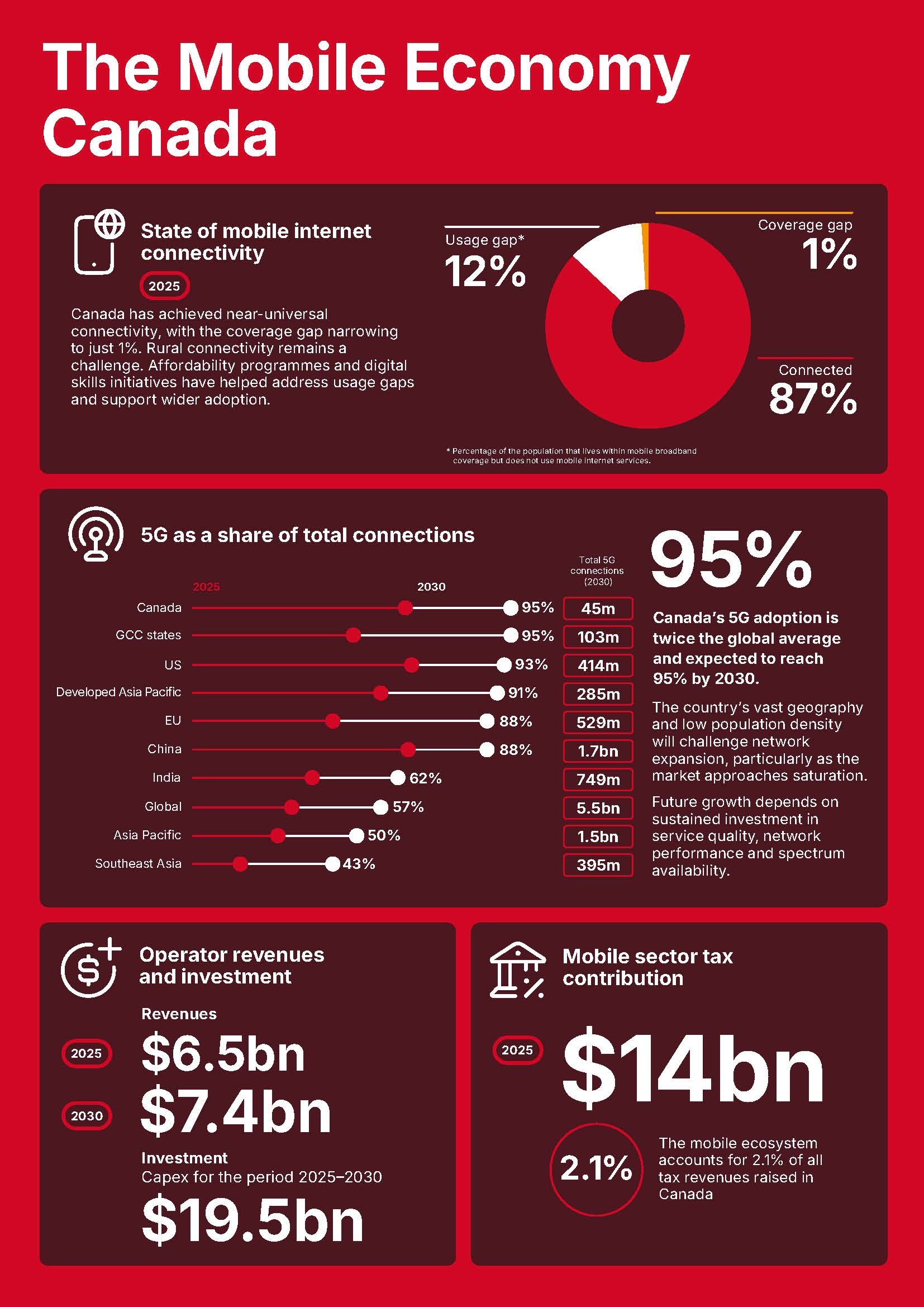 An infographic in the report highlights that 99% of Canadians live within mobile broadband coverage and 7/8 of us make use of that connectivity. Canada’s rate of 5G adoption is twice the global average.
But in my view, the kernel of the GSMA report isn’t found in looking at today’s release of a report based on yesterday’s numbers. As you might expect, I want to focus on tomorrow’s risks.
As I complain frequently, Canadian telecom policy has been dominated by affordability and competition objectives – important, but unfortunately short-sighted, with a populist, narrow focus. Eleven months ago, I wrote about a Liberal back-bencher rising in the House of Commons acknowledging the substantial drop in mobile prices being paid by consumers. “Canadians are paying lower prices for cellular services, with a 40% decline in prices over five years.” That wasn’t enough. She continued, “At a time when Canadians are concerned with rising costs and keeping their monthly bills affordable, can the Minister of Industry tell us how the government is working to lower cellphone bills?”
Industry Minister Joly proclaimed in response, “I, and this government, are laser-focused on making sure that we bring down costs in the telecom sector… We also said we would be hawkish on competition. We will do more in this budget to increase competition and make sure that we reform our telecommunications sector.”
GSMA argues that this framework was developed when mobile was a high-growth industry. Today, the market is more mature, revenue growth is slowing, and operators continue to face mounting obligations to fund 5G Standalone networks, AI infrastructure, cybersecurity, network resilience and future spectrum acquisitions.
The report advances a theme that my readers will recognize immediately: investment matters.
That theme echoes several discussions we’ve had over the past few years about the growing tension between consumer affordability and infrastructure investment. GSMA notes that Canada scores exceptionally well on wireless affordability while achieving mid-tier rankings on network performance measures, warning against policies that unintentionally undermine future investment incentives.
The 5G story is similarly nuanced. Canada has achieved more than 94% population coverage and reached one of the highest levels of 5G adoption globally, with nearly two-thirds of mobile connections already on 5G. Yet Canada ranks only 21st on the GSMA 5G Connectivity Index, highlighting a gap between broad coverage and leadership in advanced capabilities such as 5G Standalone, network slicing and enterprise applications.
Perhaps the most interesting section is found when the report focuses on AI.
GSMA sees telecom carriers becoming central players in Canada’s emerging sovereign AI ecosystem. Bell’s AI Fabric initiative, Telus’ Sovereign AI Factory, and operator investments in fibre, data centres and cloud infrastructure are presented as evidence that telecommunications networks are evolving from communications platforms into foundational AI infrastructure. At the same time, GSMA notes:
Canada faces structural constraints that could limit its AI ambitions. The most significant is the scale of its compute and data-centre infrastructure. As of September 2025, Canada had around 1.4 GW of operational datacentre capacity, versus more than 40 GW in the US.
Further, as I have written, AI cannot scale without connectivity. Every AI inference, every cloud workload and every edge computing application ultimately rides over robust communications networks. The GSMA report identifies mobile networks as a critical enabling layer for Canada’s AI ambitions.
The cybersecurity chapter is also worth reviewing. New legislation, mandatory outage reporting and growing concerns about infrastructure theft and cyberattacks are creating additional operational and financial pressures for operators. GSMA observes that resilience is more than an optional network enhancement. It is becoming a statutory obligation. How does this get funded in today’s regulatory and policy environment?
None of this means policymakers should abandon affordability objectives. Rather, the report serves as a reminder that affordability, network quality, digital sovereignty and economic growth are interconnected. Weak investment eventually translates into weaker networks, slower innovation and diminished competitiveness.
The GSMA report, The Mobile Economy Canada 2026, provides a reframing of telecommunications as something more than a consumer service. Wireless networks are a part of our national economic infrastructure, underpinning productivity, AI adoption, public safety and digital inclusion.
As Canada prepares for future releases of spectrum, AI investments, and eventually the transition toward 6G, a central question is whether the policy environment will create the investment climate necessary to sustain it.
The GSMA report can be viewed as a call for policymakers to shift from an affordability-first framework toward an improved balance of competition, consumer interests and long-term infrastructure investment – in short, a return to a more balanced approach for Canada’s telecom policy framework.
[Le rapport, “L’économie du mobile au Canada 2026”, est aussi disponible en français]