At The 2012 Canadian Telecom Summit, Industry Minister Christian Paradis promised that we would see the release of the long awaited, long overdue national digital strategy.
We are still developing a Canadian digital economy strategy. And I am committed to delivering it by the end of the year.
So I was somewhat hopeful that the release of Canada’s digital economy strategy would have been the centrepiece of the Minister’s address to the IIC earlier today in Ottawa. It is the end of October. We’re starting to run out of time for delivery by the end of the year.
There were a few words mentioning the government position on the digital economy.
Our government begins from a single premise: A strong digital economy is fundamental to the future prosperity of Canadians. It’s that simple and it’s that important.
No doubt that all of us agree. A strong digital economy is fundamental to the future prosperity of Canadians. But the key question remains unanswered: what is the strategy to guide us toward this strong digital economy?
I wrote more than a year ago that “We seem to be witnessing a stream of tactics without a clear statement of the overall objective.” The Minister mentioned some of these in his speech: the new anti-spam law, modernized copyright law, beefed up privacy laws. But our anti-spam law demonstrates the problem with creating legislation in the absence of an overall strategy. The regulations being set up to enforce the still un-proclaimed law are almost certain to inhibit the adoption of digital technologies. The law and the regulations are at odds with red-tape reduction and serve to discourage small business from leveraging cost advantages associated with digital communications.
In the meantime, we continue to look forward to the release of our overall national digital economy strategy.
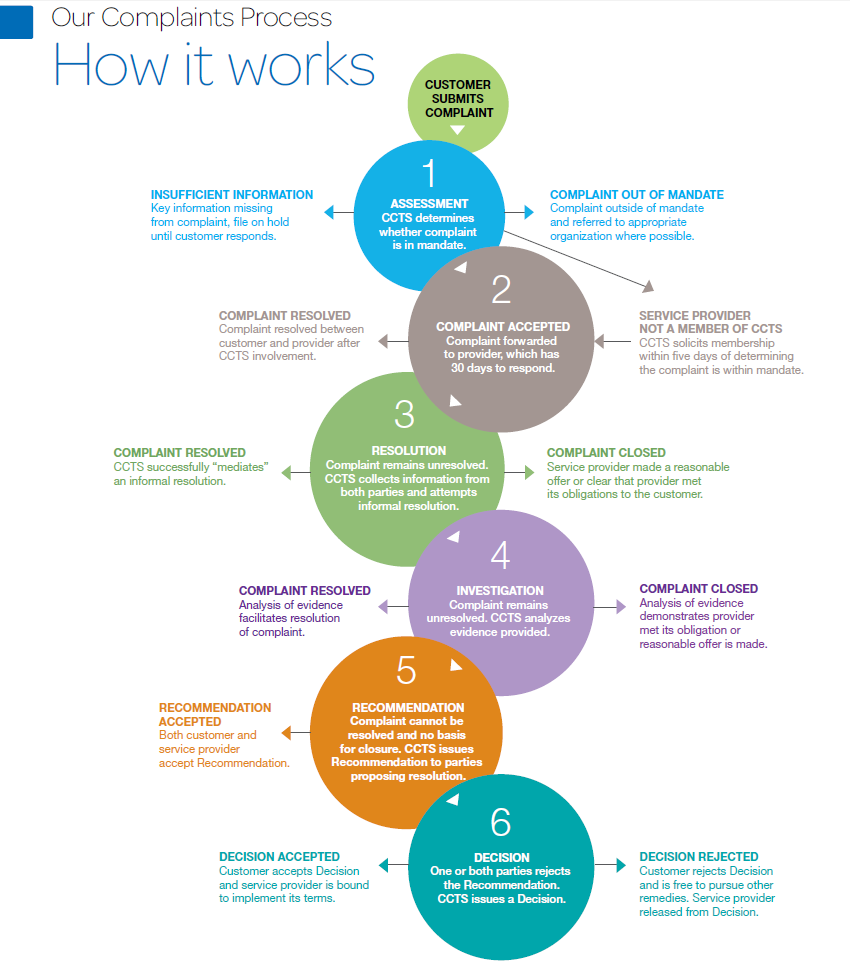
In January 2011, the CRTC expanded the mandate of the CCTS, requiring that all Canadian telecommunications service providers must participate in the CCTS process, no later than 5 days after the CCTS notifies a service provider that a complaint has been received from one of their customers.
In the past year, 38 new service providers have signed up; there are now 178 service providers and brands that are participating in the CCTS dispute resolution process. In the past year, more than 10,000 complaints were accepted by CCTS, an increase of 35% over the 8,000 accepted the previous year.
This growth is likely due to increased awareness of the CCTS as an arbitrator of last resort.
From an operational perspective, the CCTS reports that 90% of the complaints (9,626 of 10, 838) were resolved by the investigation stage, with a further thousand complaints closed by that stage, meaning that 98.5% of the complaints were concluded prior to a recommendation being required.
Just over 70% of the formal recommendations made were accepted by both the service provider and the customer.
Billing and contract issues seem to head the list of complaints. Nearly one in ten complaints dealt with early termination fees.
Fewer that 7% of the complaints dealt with service quality.
About 60% of complaints were wireless services related.
The report observed:
For example, many billing complaints arose simply because incorrect information about prices was provided to the customer, in particular when obtaining service over the phone. Others were attributable to invoices not being clear. Many billing complaints were the result of the sheer complexity of the monthly plan, in particular for wireless services and the various features, inclusions and exclusions associated with the plans. Other complaints seemed to be the result of a lack of training of customer service representatives (CSRs) about the products and services offered by the provider. In some cases, we wonder whether complaints arise because CSRs are required to meet certain sales targets or have sales incentives that increase their compensation. And of course, some billing errors occurred simply as a result of human or data entry errors. In our experience, service providers could help reduce the number of complaints about billing issues, and avoid much of the frustration experienced by their customers, by proactively addressing these matters.
Given the large number of complaints about billing issues, and the fact that many of these complaints could have been avoided, we strongly urge service providers to review their billing practices and take steps to ensure that they produce comprehensible and accurate invoices. We also recommend that appropriate training and supervision be provided to CSRs to guarantee that accurate information about products and services is provided to customers at all times, and to confirm that the customer understands and consents before service is provided.
The CCTS asks some questions that should cause industry executives to shake their heads.
If the solutions in so many cases were so “obvious” and the resolutions so “simple”, why were these customers required to bring their complaints to CCTS?
Why were the service providers’ internal complaint-handling processes unable to resolve these complaints directly with the customer at the outset?
Many service providers have multiple levels in their internal complaint-handling processes. How did these complaints get through so many levels?
How much extra time and effort was the customer forced to go through because of the service provider’s inability or unwillingness to correct obvious errors?
Six years ago, I said that executives at companies should deal with the normal customer service processes for their perquisite devices and services.
Given the choice, as an alternative to calling a carrier for customer support, I would rather undergo root canal treatment performed by a carpenter with a rusty icepick. Insert the name of whatever carrier you want. It dosn’t seem to matter which one of my service providers I happen to call.
I’ll say it again: If carriers aren’t having their employees and executives treated like a normal customer, you should change the way you handle internal accounts immediately. You need to see what you are doing to your customers. Monthly bills that are tough to read; interactive voice response units that can’t be navigated.
Some perspective is warranted. There are roughly 28M mobile lines in Canada, 10M internet access lines and 12M residential phone lines. That means 50M access services have generated these 10,000 complaints – a rate of about one per year out of 5,000 services. Not too bad, unless you are one of the victims on the receiving end.
Read the case studies in the CCTS Annual Report. Some of them will make you shake your head in wonder.
Check out the statistics at the back of the report to see which carriers have improved and which have the most work to do. Will customer care executives be watching their numbers?
For understandable reasons, many TV executives continue to dismiss the digital threat out of hand, pointing out that people still spend 5 hours a day in front of their boob tubes and arguing that the TV habit is so entrenched that satellite-cable-telco-network juggernauts will be able to maintain their chokehold and profits forever.
Such a viewpoint isn’t limited to the domain of some industry executives. Other executives have seen a different future and are trying to prepare for an alternate future.
At some point, just as it has with newspapers, this dwindling attention will be noticed by the folks who pay all those massive TV industry bills–advertisers and consumers.
And many of those advertisers and consumers will stop paying those bills–or at least radically reduce the amount they are paying.
At which point the TV industry as we know it will collapse.
Importantly, what I mean by this is NOT that people will stop watching TV content. They’ll keep watching it–some of it, anyway–just the way they’re still reading newspaper content. They’ll just get the TV content they watch in different ways (Netflix, iTunes, YouTube, Hulu). And, unlike today, they won’t get it in a way that supports the production of vast amounts of excess TV content (100s of channels) and steers humongous profits into the pockets of TV executives and shareholders.
For some time, I have been wondering about the transitional state.
At what point does a broadcaster cease to be a broadcaster from a regulatory perspective? If a content provider doesn’t broadcast over the air using public airwaves, what makes them a broadcaster subject to licensing?
At what point does a broadcast distribution undertaking (“BDU”) cease to be a BDU from a regulatory perspective? If a content delivery company uses standard public internet or even a VPN within a public internet access service, at what point does it cease to require a license?
There are now more than a billion smartphones in use in the world, up 47% from the 700M in use a year ago, according to Strategy Analytics.
An important new report from the Information and Communications Technology Council of Canada (“ICTC”) says that by year-end 2012 there will be 13 million smartphone users in Canada, up from 9.1M at the end of 2011. These users are said to have “a seemingly insatiable appetite for downloading and using mobile applications”, creating a huge opportunity for developers.
So ICTC has taken a snapshot of Canada’s app development ecosystem, exploring:
Occupations engaged in app creation;
The indirect and induced employment in the app economy labour market;
The economics of app creation: The costs associated with developing apps, funding mechanisms of app enterprises, opportunities and challenges to funding app initiatives;
The total expenditure on apps and related products and services by Canadians;
The various avenues of revenue generation and total revenue generated by Canadian app-makers;
The growth potential of the app economy and estimated job creation in this segment;
Support and encouragement required to ensure that the Canadian app makers flourish and consolidate their position on the global stage; and
Implications for policy makers with respect to talent, financing, and communications regulation.
The study [full study (630KB pdf)] finds there are 22,800 technical professionals among the 41,300 directly employed in the Canadian app economy. The Canadian app ecosystem generates $775 million per year in revenue and are estimated to reach $1.19 billion in 2014 (up 54%) and $2.2 billion in 2016 (an increase of 184%).
According to the report, nearly half (47%) the jobs in Canadian app development are found in Ontario, followed by 22% in Quebec and 15% in BC.
The report explores some interesting questions for policy makers in its final section entitled “The Way Forward”:
Should supporting nascent enterprises be prioritized?
Should necessary capital for small app enterprises be ensured?
Should creating a job market-ready workforce be emphasized?
Should integrating skilled foreign workers more effectively be prioritized?
Should collaboration with other sectors be prioritized?
Should awareness of global competition be raised?
Let me add a few other questions.
Will government intervention help or hinder Canadians competitiveness in app development? Are there policies that can help Canadians get a disproportionate share of the growing revenue opportunity? How can Canadian app developers thrive in a global market that has few barriers to entry?
According to the report:
As mobile apps continue to become the preferred means to access and consume digital products and services, it is vital that the app economy stakeholders ensure an enabling environment, a smooth path to progress, and opportunities for growth. These formative years are crucial in laying a strong foundation for sustained success. Sound skills policy, an attractive investment climate, and collaboration among all stakeholders of skilled app workforce are all key ingredients of growth and for attracting investment, as well as for Canada to gain maximum benefits from workers’ productivity gains. The app economy employs a notable number of Canadian workers and targeted measures can create a better functioning app ecosystem to benefit from competition, strengthen the business environment, and improve efficiency.
The apps development ecosystem is nascent and indeed, it is crucial that we establish a solid foundation to enable Canadians to achieve sustained and sustainable success.
How will the apps ecosystem be nurtured in the context of the long awaited national digital strategy, due to be released before the end of this year?
Videotron announced a major milestone today. The Quebec cable company now has a million customers that subscribe to at least 3 of the 4 major products in the company’s portfolion: cable TV; internet access; residential telephone service; mobile phone service).
It is a remarkable achievement especially when you consider some not so distant history.
There was a time that cable TV penetration in Quebec lagged the other provinces. With a majority French language customer base, there was not the same demand for Videotron to retrieve the major US networks, a “community antenna” which served as the fundamental basis for English Canadian cable companies.
Videotron launched its home phone service at a deeply discounted price relative to offers from other cable companies across North America. But Videotron’s counterparts in other markets started with considerably more cable TV customer penetration. Videotron’s approach helped pull through new cable subscriptions.
As of this past June 30, Videotron has
1,837,900 cable television customers,
1,425,000 of these subscribe to digital cable service
1,341,100 high-speed Internet access subscribers
347,600 subscriber connections mobile telephone service
and 1,223,400 households and organizations with cable telephone service
Not everyone hates their phone company or cable company. According to Videotron, “The love story between Videotron and Quebecers continues.” Leger Marketing has found a stellar 98% customer satisfaction rating.
It is worth considering how Videotron has built such a strong reputation with its customers.