This morning, the government released what it called “New measures to increase competition in the wireless sector“. There were a number of elements to the release, including a clear statement of the objective driving the measures: “To be clear, our government wants to see at least four players in each market.”
To that end, there were four key elements to the announcement:
expanding—and extending—the requirement for wireless companies to provide roaming on their networks to competitors;
tightening the rules to increase cellphone tower sharing, thereby helping to limit the construction of new cell towers;
use the upcoming wireless spectrum auctions to promote four competitors in each region of the country;
review the policy on spectrum licence transfers with the objective of promoting competition in the wireless sector.
The government news release contains a number of links to various background pieces, including a Commercial Mobile Spectrum Outlook that identifies more than 300 MHz of additional spectrum (beyond the 700 MHz and 2500 MHz bands) that could be made available by 2017.
There are some real cases of data roaming bill shock. A lot of people really don’t know that it can get really expensive, really fast if a smart phone connects to a foreign data network.
Many devices have settings to help avoid roaming bill shock.
One of the settings lets you disable the cellular radio; the other commonly found setting is to disable data roaming, but allow calls and text messages to come through. Both of these options will usually let you log in to WiFi hotspots at your hotel or coffee shops.
I actually think that devices should come pre-configured with data roaming disabled as the default setting.
For some reason, I am not feeling sympathetic to the latest story that was created by CBC’s Go Public. From the time I first heard about it, a number of questions ran through my mind.
CBC’s headline reads “Dad gets $22,000 data roaming ‘shock’ from Fido”.
In fact, there was no bill for $22,000. The kid used data that would have cost $22,000 if Rogers had not first adjusted the bill to reflect the prices that would have been charged if the parent had signed up for a discounted data plan. But that doesn’t attract eyeballs the same way.
The video clip that aired is introduced by an announcer who said:
A Burnaby man is going public tonight after getting a $22,000 phone bill.
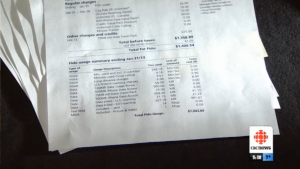
That simply was not true. CBC was wrong. As it turns out, he never received a bill for $22,000. CBC knew that. In fact, CBC shows the bill in the video (the image reproduced here is from a freeze on the 1:08 mark of the CBC video). You can clearly see that the total bill, including regular monthly charges and tax comes to only $1400. That is a lot, but barely 5% of the headline.
From the bill, we can see that this is a family that was fully aware of possible data roaming charges. The bill shows a regular US data roaming subscription. In the story, the parent describes visiting the Apple store to find out how to avoid charges.
However, the 11 year-old son got a sunburn and was left in the hotel room with the family iPhone to play with. As the story goes, the kid turned on data roaming and spent 3 days watching YouTube videos.
Normally, a text message is sent to warn customers that welcomes the user to a foreign land and provides instructions on rates and how to manage roaming costs. For example, one of my phones recently received one that said:
Rogers TIP: You’re Roaming. Stay connected with an affordable and easy to use roaming offer. If you don’t already have one, simply click http://rogers.com/m/apac (no charge) to quickly view your options. Without a roaming offer, regular roaming rates are $3/min $0.75/txt $0.03/kB (+ taxes). FYI: Email, browsing, Visual Voicemail, MMS, IM, BBM & Apps use data. If you still require assistance please call Rogers free of charge at +1-514-734-7699
According to the article, no such message was received, although it is not known whether such an incoming message was deleted.
Contrary to the paragraph in the CBC story that claims “Currently, the only way for a customer to access data outside the country for less — through their carrier — is to buy a roaming package, before leaving”, you can subscribe to discounted data plans once you arrive in your destination.
The bill appears to reflect a substantial reduction in the charges that might otherwise have been incurred. We are told that the kid consumed 700MB of data over three days, two of which are on the current bill. From the vidcap of the bill, we can see that there is a line item for a 75 MB package plus overage charges for another 327 MB. That means that next months bill will have another 300 MB or so. This month’s data bill is $1200; next month, at the same rate, will be about $1000. It is a lot, but there is no bill for $22,000.
And contrary to the opening of the news story, there was no bill for $22,000. The author of the CBC story says that she isn’t responsible for the intro. In a tweet since removed, she wrote: “@CBCGoPublic: That was intro to story not written by me which aired hours ago. Story clearly stated $2200. I am done here.”
In fact, the story talks about $22,000 four times (plus the headline and the caption to the video) before you get to the 9th paragraph, where it states “Fido immediately said it would cut the bill to $2,200.” Cut the bill? There was no $22,000 bill. All evidence seems to be that the only bill that was sent was for $2200.
Just a sensational headline, under the banner of the national broadcaster, perhaps intended to influence CRTC members who are considering such matters as part of the Wireless Code of Conduct. It might have been interesting to hear if CBC asked the parents how they felt about leaving their child unattended in a Mexican hotel room for 3 days. Did CBC check the deleted messages folder to see if the warning text message was accidentally erased?
I am sympathetic to many cases of data roaming bill shock. This just isn’t one of them.
I have written in the past about the excellent book Start-up Nation by Dan Senor, exploring the entrepreneurial success of Israel in creating high performing technology companies.
Yesterday, Singapore Telecommunications and Amdocs announced that they are establishing a joint R&D centre in Raanana as part of SingTel’s investment in new technology. Amdocs already operates a similar centre jointly with AT&T.
SingTel said its initial focus will be on voice and facial recognition as well as systems that enable mobile and Wi-Fi networks to work more efficiently.
“More and more mobile customers are using mobile devices for more than just communications,” said Allen Lew, chief executive of SingTel’s digital life group. “In our business it’s not enough to be up to date, we have to be up to tomorrow.”
It makes me wonder if any Canadian carriers are looking at similar ventures.
One of the sessions at The 2013 Canadian Telecom Summit in June will be looking at Building an Innovation Economy. The panel is being moderated by Namir Anani, who heads up the ICT Council of Canada. Panelists include Chris Hodgson of Google, Warren Jestin of Scotiabank, Ron Styles of SaskTel and John Weigelt of Microsoft Canada.
Indeed, I would commend the Washington Post article and the survey itself to you for reading.
I want to highlight the problem representing the survey results in the Washington Post. The fifth paragraph says:
Half of all students in higher income families have access to the Internet at home through a computer or mobile device. The figure drops to 20 percent for middle income children and just 3 percent of students from poor homes, according to the survey of 2,462 teachers by the Pew Internet & American Life Project in cooperation with the College Board and National Writing Project.
Something seemed off with those figures.
After all, I recalled that two weeks ago, I wrote about digital literacy programs trying to deal with the one-third of American households that aren’t on-line. How could it be that half of wealthy households with kids were without internet, if the national figures show two-thirds of households have internet access.
Something wasn’t right.
In going to the actual Pew report, I found the likely source of the Washington Post numbers. But Pew didn’t actually report on the availability of home internet by income. It was a different question.
The survey reported “% of teachers who say ALL or ALMOST ALL of their students have sufficient access to the digital tools they need [at home / at school] to effectively complete school assignments, by student socioeconomic status”.
This question may point to whether teachers have to adapt homework assignments; can the teachers assume that digital tools will be available?
The Washington Post appears to have treated these numbers as though the question asked “percentage of students who have home internet, by income.”
The Washington Post question is important to understand and address, but it was not addressed in the survey. And as a result, the numbers were just plain wrong.
[2:25pm update] The Washington Post article has been corrected.
In an interview with Greg O’Brien at Cartt.ca, Industry Minister Christian Paradis gave previews of a number of coming attractions.
On the topic of the long awaited digital economy strategy, we are told to wait a little longer, but it will indeed be coming at some point after the next federal budget. Addressing previous commitments to release the strategy before the end of 2012, the Minister told Cartt.ca: “I wish it had come last year but frankly it would have been irresponsible.”
Cartt.ca also confirmed that the 700MHz auction will be postponed to the second half of the year, with the 2500MHz auction following closely behind in early 2014.
The interview turned to the subject of broadband for low income households:
Greg O’Brien: But will such a broadband push be part of the digital economy strategy? Can you look to the Connect2Compete program in the States and encourage something like that to happen here because that program doesn’t even involve any government money, it’s just a government push to get the carriers to act.
Christian Paradis: Yes, it’s a government push there and here the CRTC has jurisdiction over this. I am well aware of what you are talking about and I can tell you that some avenues are being studied as we speak and now the idea is to understand who can do what and some work is being done in the industry as we speak. This is something very interesting and hopefully when we come out with the strategy there will probably be some more clarification about that, but I don’t want it to seem like a pre-announcement because there is some information that needs to be sorted out as we speak.
I am not sure that I understand the punting of “jurisdiction” to the CRTC, but it was interesting to read the Minister’s statements about “some avenues are being studied” and work “being done in the industry as we speak.”