The CRTC issued a statement on losing a procedural motion at the Federal Court of Appeal in the case of the implementation timing for Wireless Code described in my posts from last summer – here and here.
It was a strange statement from the CRTC. Did losing a procedural motion merit a press release? Why would the CRTC try to appeal to the public, highlighting this ruling? As any law student, or viewer of court room drama on TV would know, a regulator or judge can’t show up at the appeal court to advocate in favour of its decision. The ruling needs to stand on its own merit.
Here is what the judge said in ruling against the CRTC:
A statutory appeal, or an application for judicial review is not an occasion for the tribunal to improve upon its reasons in light of the objections made to them by the litigants.
So the Federal Court of Appeal struck 60 paragraphs from the CRTC’s memorandum.
The case before the Court of Appeal is fundamentally about the extent of legal powers of the CRTC. The first question is whether limiting termination fees in older mobile contracts is a form of retroactive rate-making. In the past, the courts have already held that the CRTC does not have retroactive rate-making powers. Alternatively, are there other proscriptive powers that might allow the CRTC to override existing contracts?
This is the heart of the case being heard by the Federal Court of Appeal. It is an important test of the extent and limits of CRTC legal powers.
Retired General Rick Hillier will be the first day closing keynote speaker leading into cocktails on June 16, addressing delegates at The 2014 Canadian Telecom Summit.
Born in Newfoundland and Labrador, General Rick Hillier joined the Canadian Forces as soon as he could. Throughout his career, General Hillier has had the privilege and pleasure of commanding troops from the platoon to multi-national formation level within Canada, Europe, Asia and the United States. He has worked as a staff officer in several headquarters, first at the Army level in Montreal and later at the strategic level in Ottawa. General Hillier was promoted to Chief of the Defence Staff in 2005. He retired in August 2008.
General Hillier will speak about “Leadership in Difficult Times.”
And these are most definitely challenging times for leaders in the Canadian telecommunications sector.
More than 70 of the people who shape Canada’s communications sector will be speaking at The 2014 Canadian Telecom Summit, June 16-18, at the Toronto Congress Centre.
You should be there too. Why don’t you register today?
The story says that the agency lost an unencrypted hard drive during an office relocation in mid-February. The Star report says the drive had private earnings information including names, official ID numbers, salary and overtime, for current and former employees of the Office of the Privacy Commissioner and the Office of the Information Commissioner.
Although the drive was lost in mid-February, the information technology department did not notice the drive was missing until mid-March. The Toronto Star article says that it took until April 9 for the IT people to realize that missing drive had personal information. Still, 180 current employees were told about the breach last week; another 600 former employees had still not been informed.
Under proposed legislation recently introduced in the Senate [Bill S-4: The Digital Privacy Act], notification must be given “as soon as feasible after the organization determines that the breach has occurred.” Will the timeline for notification by the Privacy Commissioner help inform a definition of “as soon as feasible”?
Who polices a breach of data privacy by the office charged with policing such matters? At the bottom of the Star story, we are told that the RCMP has not been called in to investigate since there is no indication of a criminal act. An internal investigation is said to be expected to return findings on Friday. According to the story, Parliament was notified through the Ethics Committee and the speakers of the House and Senate.
Privacy, security, telemarketing rules, anti-spam, and so much more will all be discussed at The 2014 Canadian Telecom Summit, June 16-18 in Toronto. Have you registered yet?
The most influential leaders of the Canadian & International ICT industry will gather in Toronto from June 16-18 at The 2014 Canadian Telecom Summit. Alone, any of our keynote speakers would be well worth listening to. The Canadian Telecom Summit brings over a dozen keynote address – and more than 50 panelists – over 3 unmatched days of presentations, discussions, sharing ideas, forming relationships and even deal-making.
Now in its 13th year, The Canadian Telecom Summit has grown to become Canada’s most important annual telecommunications & IT event, attracting hundreds of attendees from around the world. No other event presents a complete picture of current and expected trends & developments. No other event matches The 2014 Canadian Telecom Summit for the depth and breadth of topics covered and issues debated.
This year, in addition to its ever popular Regulatory Blockbuster, we are featuring sessions devoted to:
The Continuing Evolution of TV;
Cloud, Big Data and the Transformative Power of the Network;
Cyber Defense;
Competition in Telecom;
Customer Experience Management;
Converged Business Models;
The Digitization of Canada’s Economy: a report card on progress, a prescription for the future;
Rage of the Machine: The growth of NFC, M2M, Mobile Commerce & More; and
CIO/CTO Roundtable.
Come see why The Canadian Telecom Summit has become the only must-attend conference. With more opportunities than ever to learn, network and do business, if you are involved with or impacted by Canadian telecommunications, broadcasting or information technology, you need to be at The 2014 Canadian Telecom Summit.
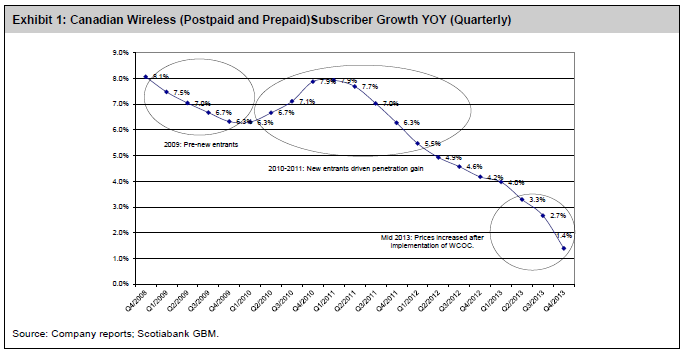
Scotia Capital has released some new reports on the Canadian wireless market, one in direct response to news late last week about a new offer by TELUS to acquire Mobilicity.
The other report, Scotia’s Converging Networks report for the week of March 31, observes “At this pace, we are trending toward no subscriber growth and no penetration growth in 2014.”
The Scotia Capital report sees revenue growth also slowing. Price increases have had a slowing effect on service revenue growth and data revenue growth, caused primarily by slower growth in smartphone subscribers (and smartphone penetration growth), which fuel data revenue growth. “As smartphone subscriber and smartphone penetration growth slow, so does data revenue growth.”
TELUS tried to acquire Mobilicity in mid-2013 and unofficially again later in 2013 but was rejected both times by Industry Canada (IC). Mobilicity has been under CCAA since Sept 2013 and received 5 official bids. Mobilicity stated TELUS is the only one acceptable. In the Mobilicity release, there were a number of concessions if the transaction is approved.
We believe that this deal is “dead on arrival” for the regulators but at this point, there is no real downside to TELUS’ move. Plan A is to have the bankruptcy court overrule IC’s rejection. If the court sides with IC, then we think that plan B would be for Mobilicity to pursue the next bid (or wait for another lower offer to emerge). The lower offer would help Mobilicity crystallize the “damage” for potential legal action against IC in the future.
We do not believe IC will budge on allowing the transfer of set-aside spectrum licenses to the incumbents. Prices are again on the rise and we are not sure what victory the government can really declare. We believe IC is determined to devalue Wind and Mobilicity to the point that it becomes attractive for consolidation. It is not even clear that IC will even let SJR or QBR sell their spectrum licenses to RCI under their option agreements.
It is a powerful set of observations on the level of intervention by Industry Canada in the wireless marketplace. In one bullet, Scotia Capital observes that there could be lawsuits against the government for changing the spectrum transfer rules (potentially with 9 figure damages), and in another bullet, Scotia suggests the government is intentionally devaluing two of the new entrants.
Is this consistent with the spectrum transfer rules that were the subject of a blog post last week? Those rules require that “market forces should be relied upon to the maximum extent feasible” and “regulatory measures, where required, should be minimally intrusive, efficient and effective.”
The people who will lead the development of Canada’s digital future are gathering in Toronto from June 16-18 at The 2014 Canadian Telecom Summit. Now in its 13th year, this year’s event will explore a theme of “Future-proofing Our Place in a Digital World”, examining the technologies, services, systems, regulations and policies that are at the foundation of a global digital economy.
The state of telecom competitiveness in Canada will be the subject of a panel on Monday June 16, featuring some of North American’s leading telecom economists. The convergence of content anywhere is the subject of a panel that will be moderated by Scotia Capital’s Jeff Fan, also on June 16. Be sure to book your place at The Canadian Telecom Summit, June 16-18, in Toronto.