Some of the things I have been thinking about this week. Perhaps they will percolate into a bigger post over the summer. Otherwise, I thought I would share these thoughts with you. Please feel free to comment.
Over the past few years, Canada has enacted a number of regulatory and legislative constraints on the delivery of content over the internet. Some have been proclaimed (with pride) as being first in the world, such as internet traffic management, or among the most protective, in the case of anti-spam laws.
It may be worthwhile for some academic researchers to take a look at the impact of regulating internet content in Canada, from an economic perspective, social policy, cultural issues, etc.
Are we restricting the evolution of creative business models and innovation through regulation?
The government couldn’t be happier. The CRTC has reported since the that it has already received more than a thousand complaints since the anti-spam law took effect on Tuesday. CBC reported in the most dramatic fashion: CRTC flooded with more than 1,000 anti-spam complaints. “Flooded”!
The Industry Minister’s press secretary went onto Twitter boasting that this is evidence of how serious a problem we have:
How does the sudden tracking of complaints show spam is a serious problem? 10 years after there was an anti-spam task force – that’s right, 10 years – the press secretary to the Industry Minister says that 1000 complaints “shows this is a serious problem.”
The reality is that 1000 isn’t really such a large number. Remember that there are more than 30 million internet users in Canada and there are billions of spam messages being trapped by Canadians’ email systems every day – most never reaching the end user. The 1000 complaints from 35 million users should be compared to about 500 complaints being received by the CRTC every day for violations of the national Do Not Call List – a system that has been operating for more than 5 years already. There are only about 40% as many phone numbers in the DNCL as there are email users. So the CRTC was not “flooded” with complaints.
Unfortunately, the number of complaints doesn’t indicate anything about the effectiveness of the solution. Or the lack of effectiveness of this government’s solution. Or the cost to the economy of what has been imposed.
One might have hoped that 10 years would have produced better evidence.
Of course, proper evidence might have avoided the regulatory over-reach of Canada’s Anti-Spam Law (CASL). Jeffrey Graham, of Borden Ladner Gervais asks “Why would it not be enough for the law to simply provide that if there is an existing relationship, broadly defined, and an effective opt out right clearly identified in the promotional emails, the public interest is adequately protected?” In his OpEd in the Financial Post, he says that the compliance costs could be in the hundreds of millions of dollars.
The anti-spam law, he says, is an infringement on “commercial speech,” which is guaranteed under the Charter of Rights and Freedoms. The law “ignores that consumers benefit from receiving useful information about products and services” ‘ from businesses. It increases competition and expands consumers’ market knowledge.
Commercial Electronic Messages – and I mean otherwise legal, non-fraudulent, non-malicious messages – increase competition and expand market knowledge. Why would we want to block increased competition?
If there are consumers who believe that CASL is worth the costs of compliance for Canada’s business community, I wonder if they understand the costs that are ultimately being borne by them? The direct costs will ultimately be passed on to Canadian consumers, as will the costs associated with reduced competition and reduced market knowledge.
Our government has imposed yet another impediment to the adoption of e-commerce and information technology in Canada. It is another contributor to lower levels of competition across the board in Canada’s economy.
Once again, CPAC recorded portions of The 2014 Canadian Telecom Summit and a number of sessions are now available for viewing on demand:
Keynote address – Monday, June 16, 2014: Guy Laurence, President & CEO, Rogers Communications
Panel – Competition in Telecom – Monday, June 16, 2014: Robert Crandall (Brookings Institution), John Mayo (Georgetown University), Eli Noam (Columbia University), Roger Ware (Queen’s University), Leonard Waverman (McMaster University) and moderated by Dvai Ghose (Canaccord Genuity)
Panel – The Continuing Evolution of TV – Monday, June 16, 2014: Dave Caputo (Sandvine), Dragan Nerandzic (Ericsson Canada), Charlotte Burke (Quickplay Media), Michael Hennessy (CMPA), David Purdy (Rogers Communications) and moderated by Jeff Fan (Scotiabank)
Keynote address – Monday, June 16, 2014: Bernard Lord, President & CEO, CWTA
Keynote address – Tuesday, June 17, 2014: Tony Ciceretto, President & CEO, Cogeco Data Services and Peer 1 Hosting
Panel – The Regulatory Blockbuster – Tuesday, June 17, 2014: Jonathan Daniels (Bell), Ken Engelhart (Rogers Communications), Ted Woodhead (TELUS), Chris Tacit (Tacit Law), Simon Lockie (WIND Mobile) and moderated by Greg O’Brien (editor, Cartt.ca)
Fireside chat – Tuesday, June 17, 2014: Jay Mehr, EVP & COO, Shaw Communications
Keynote address – Wednesday, June 18, 2014: Pierre Dion, President & CEO, Quebecor
Whether you were at The 2014 Canadian Telecom Summit or not, all of these sessions provide important summer viewing and a taste of what takes place each year at Canada’s most important ICT event.
Be sure to get on the mailing list for The Canadian Telecom Summit. The 2015 event will take place in Toronto, June 1-3, 2015.
The Minister replied to this post with two different tweets:
and
Now, in reality, I don’t believe CASL will save anyone any money.
The “billions” to which the Minister is referring is the cost of spam and malicious electronic content. On the government’s Fight Spam website, we see a reference to “spam” as “often a source of scams, computer viruses and offensive content that takes up valuable time and increases costs for consumers, business and governments.”
The introduction of CASL doesn’t mean that we can all stop paying for anti-virus software. CASL won’t reduce the burden on IT departments to invest in countermeasures to safeguard corporate digital assets. Offensive, malicious and harmful content will continue to infect our computers and will threaten even more devices as our “things” become networked, as attendees of The 2014 Canadian Telecom Summit heard two weeks ago from a number of presenters.
CASL will not reduce the costs of safeguarding our digital property any more than 3000 year old laws against stealing have provided financial relief for the costs of insurance and security systems for my home.
So, a lot of companies got their records caught up and cleaned up and can now send email updates to folks who have explicitly opted into their mailing lists.
But the Canadian Federation of Independent Business says that only 15% of its 109,000 small business owners are aware of all the requirements and 62% of them have taken no steps to comply. So the 5 years to prepare didn’t help Canada’s existing million small businesses prepare. And Industry Canada numbers show there are an average of 100,000 new small businesses created every year. They never had the advantage of getting a CASL-free email blast to try to get explicit authorization to send emails. Just asking for permission is a violation of CASL’s rules.
I suspect that what most Canadians want is a quite different law from what we got.
I agree. But CASL goes far beyond stopping what most of us consider to be spam. CASL goes beyond “constantly send[ing] unwanted emails“. It doesn’t allow a single unwanted email. even if the content is not fraudulent, the sender is not hiding their identity, the sender observes all unsubscribe requests. [For an excellent description of CASL, let me recommend Barry Sookman’s recent CASL Unofficial FAQ blog post.]
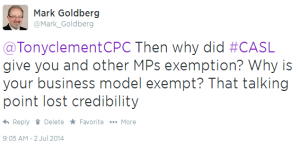
So, I agree that our anti-spam laws should be targeting those who have a business model to constantly send unwanted emails. I also have zero sympathy for them. But it is interesting that the politicians gave themselves an exemption from CASL. Was it a matter of them recognizing the burden of the law? Is there a reason why members of parliament are allowed to have a business model that permits them to “constantly send unwanted emails”?
As I replied to Mr. Clement, this talking point (which I have seen before on Twitter) loses its credibility when spoken by people who are exempted from conforming with the law.
Mr. Clement, as a former Industry Minister, is very familiar with this file. As he noted, the law was passed by Parliament. But, I am left wondering if we Canadians are stuck with digital policies that can fit into 140-character tweets.
Yes, spam and harmful electronic messages cost billions to the economy. But let’s be clear: CASL is not going to remove those costs and “save SMEs billions.” Yes, we should try to protect Canadians from constant unwanted emails. But CASL over-reaches beyond that objective.
The general purpose of Canada’s Anti-spam Legislation (CASL) is to encourage the growth of electronic commerce by ensuring confidence and trust in the online marketplace. To do so, the Act prohibits damaging and deceptive spam, spyware, malicious code, botnets, and other related network threats.
I agree with these objectives completely. But we all need to ask: “How did we stray so far?” What we have implemented will not encourage the growth of electronic commerce. It prohibits new businesses in your neighbourhood from announcing their presence electronically, even though such an announcement is completely legal in print form.
CASL censors communications in digital form that are otherwise completely legal. That should concern us all.
How did our members of Parliament lose sight of these objectives when framing the legislation?
As I wrote 5 years ago, Twitter is my Coffee Crisp. It makes a nice light snack, but we still need the main course enabled by this lengthier blog post – much lengthier, in this particular case.
TELUS WISE will offer seminars and online resources that will help keep all members of Canadian families safer online. It is not just an online resource; TELUS WISE ambassadors will come out to any local community group to conduct in-person seminars on Internet and smartphone safety – a workplace, community centre, school, parenting group or senior’s centre, for example. Individuals can also book a one-on-one session with trained staff at more than 200 TELUS stores. Educational materials will also be available on a secure portal, available to anyone who wants to educate themselves on the safe use of smartphones, tablets and computers.
Two weeks ago, TELUS was recognized by CACP, the Canadian Association of Chiefs of Police, for helping Canadian families stay safe online.
CACP has officially endorsed TELUS WISE, which has already reached more than 350,000 Canadians. The CACP Board of Directors is encouraging policing services to use the TELUS WISE program across the country, making the program materials and resources available to families in their communities.
The TELUS WISE program has two components – one aimed at adults and a second (called “TELUS WISE footprint”) which appeals directly to youth. TELUS regularly schedules free, in-person public TELUS WISE seminars led by specially-trained TELUS team members at convenient public locations. Groups of ten or more can book their own seminars in the workplace, at a community centre, in a school, at a parenting group or seniors’ centre. Individuals can also book one-on-one sessions at more than 200 TELUS stores nationwide. TELUS WISE and TELUS WISE footprint educational materials are available on a secure TELUS WISE portal for anyone interested in self-education on the safe use of smartphones, tablets and computers.
We need to create the right conditions for Canada to lead in a global digital economy:
We need to drive a greater degree of digital inclusiveness for all Canadians, young and old, urban and rural, regardless of their economic station.
We need programs to increase digital literacy and access for disadvantaged Canadians.
We need to drive increased adoption of Information and Communications Technology in business
We need to improve ICT adoption in all dealings with government, especially in improving the quality and efficiency of health care delivery, and
Our customers need to be confident that they can engage online securely and with their privacy safeguarded.
… it may be up to those of us in this room, gathered here at The Canadian Telecom Summit, representing the leading stakeholders in Canada’s innovation agenda, to develop and impart the vision to create a Digital Canada.
TELUS WISE is precisely the type of private sector leadership of which we spoke, “to develop and impart the vision to create a Digital Canada.”
The program deserves the recognition it received from CACP.