CNN Money featured a story about Neverware, a start-up launched by a colleague of my son: “Neverware is reviving old school computers“. Neverware created software that revives old computers and gets them running like new again, basically converting older PCs and Macs into a Google Chromebook.
By running everything in a web browser, the operating system puts much less strain on the computer’s hardware and can make the old machines feel new again. (It works with any computer manufactured in the last eight years.)
Neverware targets the school market, but it may be interesting to explore this approach to get lower cost devices into households that can’t afford to get computers for school aged children.
We need creative solutions to ensure that all of Canada’s school-aged children have access to a connected computer at home.
Will Neverware be able to help bring more devices to more kids in Canada?
I am not usually a big believer in municipal broadband projects.
I have been around the telecom industry long enough to remember government owned monopoly telecom carriers as the norm around the world. With few exceptions, governments are not known for customer service excellence.
Similarly, municipal broadband projects have had spotty records. Think about our roads and water and you recognize the challenge. Municipalities tend to follow “just too late” maintenance and service expansion.
An editorial in the Toronto Star endorses a proposal “to eliminate an income-based “digital divide” that hinders many of the poor from accessing information via high-speed Internet”, by bringing free WiFi to all Toronto Community Housing buildings, parks, civic squares, plazas and other public spaces.
This proposal could be interesting, especially if the city works in cooperation with private sector partners who can be contracted to provide support, training and most importantly, maintaining service quality at the highest levels. The aspect I like the most is that it targets a specific problem: increasing connectivity for low income households.
We need creative solutions to make sure that low income households have access to connected devices. School kids need computers with internet connections to be able to do homework at home – libraries and school computers simply aren’t enough. About 15% of Toronto’s households have no computer and have no broadband connection. Low cost (or free) connectivity is one part of the solution; we need to look at getting devices into these households as well.
Two years ago, a proposal never got past the committee stage “in the face of loud opposition from a small lobby concerned about the health effects of WiFi signals.” Let’s hope that junk science doesn’t derail an important discussion of possible ways to bring digital equality to those who can’t afford conventional services.
My first video recorder (circa 1984) was a Sony Betamax.
The Beta format had hi-fi stereo recording capabilities before that was available in VHS and the picture quality was considered better, but the smaller cassette size limited the recording length on a single tape. For the handful of people who figured out how to program their video cassette recorders, VHS won the format battle because it could handle 6 hours on a single tape, equivalent to a full week of a favourite soap opera for weekend binge viewing.
While BB10, in our opinion, is technologically superior to many mobile platforms, it has failed to generate the recovery BlackBerry had hoped for and continues to be the primary source of losses for the company
One has to ask if Blackberry is offering a technically superior solution that the broad marketplace simply doesn’t value sufficiently to allow the product to remain viable.
Is my Blackberry going to move into the same museum as my Betamax?
When Canada first launched its consultation for a national digital strategy, there was such promise.
The announcement was made jointly by Tony Clement (then Minister of Industry), James Moore (then Minister of Canadian Heritage and Official Languages), and Diane Finley (then Minister of Human Resources and Skills Development). It was promising to see a comprehensive, tri-departmental approach. After all, Industry would cover the issues of carriage and growth of the ICT sector, Heritage would represent the issues associated with content and Human Resources would deal with, well, human resources.
The original consultation included a discussion paper providing details on 5 broad themes being considered – themes that corresponded to the breadth of responsibilities that were represented by the Ministers:
Capacity to Innovate Using Digital Technologies;
Building a World-Class Digital Infrastructure;
Growing the Information and Communications Technology Industry;
Digital Media: Creating Canada’s Digital Content Advantage; and
Building Digital Skills for Tomorrow.
Four years later, when the long overdue “strategy” was released, the document didn’t seem to address many of the issues raised by various parties in response to the consultation.
By the time the digital strategy was actually released, only the Minister of Industry was part of the announcement.
The 26-page Digital Canada 150 pamphlet [pdf] contained just 2 actions related to “building digital skills for tomorrow”:
“Support for the Computers for Schools Program will continue to provide students and interns with access to digital equipment and skills training”;
and, “We have realigned programs to support digital skills development and promote enrolment in key disciplines related to the digital economy.”
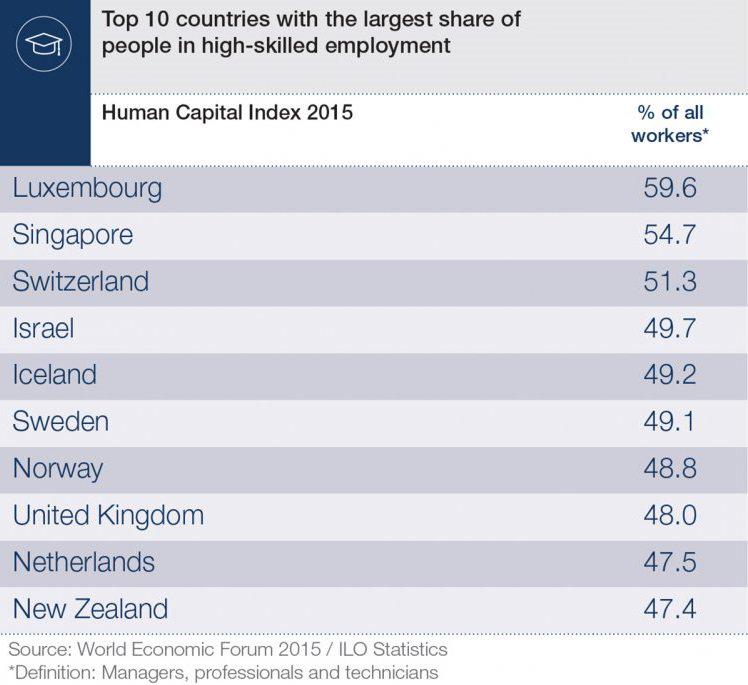
I noticed two interesting charts that show the importance of investing more resources in understanding how a skilled work force can contribute to Canada’s performance in a global digital economy.
The first chart examines which countries have the highest proportion of the population employed in skilled jobs; the second looks at the most innovative countries.
Singapore, Sweden, Switzerland and Israel are on both of those lists. We should try to understand that correlation.
As ICTC indicated in announcing its digital talent strategy consultation, “The key to ensuring that Canada is set up for success is to ensure that there skilled talent to drive innovation and competitiveness, as entrepreneurs or as part of the workforce.”
After more than a decade of investing in infrastructure, will the next government do more to invest in people? What are the best ways for the government to promote digital skills development?
The 2015 edition of The Canadian ISP Summit will be taking place November 9-11 at the Toronto Marriott Downtown Eaton Centre.
I will be moderating the closing panel on the afternoon of November 11, The Regulatory Forum, with Chris Tacit, Jonathan Daniels and Michael Geist. Chris is a lawyer who does considerable work for Canada’s independent ISPs; Jonathan is VP of Regulatory Law at Bell; and, Michael is a law professor at University of Ottawa.
The four of us have been doing this panel for a few years now and it is fun, often feisty, and informative. We’ll be talking about such issues as the Basic Service Obligation proceeding, MVNOs, Quebec wanting ISPs to block gambling websites, and much more. What issues would you like us to cover?