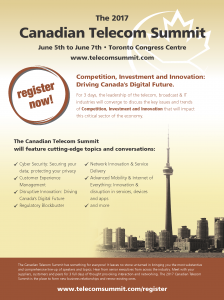
Driving Canada’s digital future

Before many of us take a break for the holidays, I wanted to let you know that registrations are now open for The 2017 Canadian Telecom Summit, taking place June 5 – 7, 2017 in Toronto.

Visit the conference website often to see the program as it continues to develop.

Now in its 16th year, The Canadian Telecom Summit is Canada’s leading ICT event, attracting the most influential people who shape the future direction of communications and information technology in Canada.

For 3 full days, The Canadian Telecom Summit delivers thought provoking presentations from the prime shapers of the industry. This is your chance to hear from and talk with them in both a structured atmosphere of frank discussion and high-octane idea exchange and schmooze in a more relaxed social setting of genial conversation.

Covering the entire industry
Once again, you will have the opportunity to interact with executives of leading service providers, equipment suppliers, applications developers, policy makers, regulators and major customers.

In-depth panels will examine:

  • Cyber Security;
  • Big Data & Analytics;
  • Customer Experience Management;
  • Disruptive Innovation: Driving Canada’s Digital Future;
  • Future of Business Communications: Innovative, Unified & Collaborative;
  • Network Innovation & Service Delivery;
  • Advanced Mobility: innovation & disruption in services, devices and apps
  • and of course, the not-to-be-missed Regulatory Blockbuster.

The “Canadian Telecommunications Employer of Choice” and the “Top Canadian Telecom CEO” award programs are now accepting applications. Don’t miss your opportunity to get recognized as one of the best in the industry. For more information visit the awards website, or call Jeff at +1.416.886.7007.

Plan to attend
If your interests lie in the Telecommunications, IT or Broadcasting sectors, you need to attend The 2017 Canadian Telecom Summit. Mark the dates on your calendar: June 5 – 7, 2017.

Take advantage of early bird registration rates by reserving your place now.

See you at The 2017 Canadian Telecom Summit!

Driving competition, investment and innovation

It is a competitive world out there. Regardless of free trade agreements, the digital economy largely transcends international borders, subject of course to legal bounds [an interesting case on that matter – Google vs Equustek Solutions – is being heard today by the Supreme Court of Canada]. Applications generated by coders anywhere in the world are made available and sold worldwide, bypassing border security and customs agents without any delays or protective tariffs.

That raises a number of questions that policy makers and business leaders should be considering:

  • What kinds of communications infrastructure is needed to provide Canadians with a platform to excel in a global digital economy?
  • What are the characteristics of a policy framework that fosters the development of innovative new applications and technologies to deploy in Canada and offer around the world?
  • What conditions are needed to encourage investment of capital and the availability of competitive communications services to Canadian consumers and businesses, regardless of where they are located?
  • How can low income Canadians participate in a more inclusive digital future?
  • How can communications services and applications be refined and developed with a goal for competitors to offer choice and differentiated services to all Canadians?

What will be the impact on Canada from a transition in US communications regulatory policy as the FCC transitions to the new administration? See Hal Singer’s post, “Wondering What A Trump FCC Might Look Like? Here’s A Preview“. Will Canadian consumers have access to the same types of offers as their neighbours to the south? Will Canadian businesses, whether incumbents or entrepreneurs, be able to innovate and launch new capabilities as well? What opportunities will the creative community find?

Registrations are now open for The 2017 Canadian Telecom Summit, taking place June 5-7 in Toronto. We’ll explore all of these issues and more.

Reading, writing and ‘rithmetic

Grade 4 ScienceGrade 4 MathCanadians should be concerned about mathematics and science education in our elementary schools, according to the latest release by Trends in International Mathematics and Science Study (TIMSS), a report on student achievement around the world.

Canada ranked 29th in Grade 4 math, well behind leaders Singapore, Hong Kong, Korea, Taiwan and Japan. The US ranked 14th. By the time our kids reach grade 8, our ranking moves up to 8th, still behind Singapore, Korea, Taiwan, Hong Kong, Japan, Russia and effectively tied with Kazakhstan (the US is marginally behind Canada).

In Grade 4 science, Canada ranks 23rd; the US ranks 10th. Grade 8 science shows Canada in 13th place, still two places behind the US.

Recent “investments” have been announced for universities [such as here, here, and here, among many, many more]. Each announcement includes the statement “Canada’s Innovation Agenda aims to make this country a global centre for innovation—one that creates jobs, drives growth across all industries and improves the lives of all Canadians. This investment exemplifies that vision in action.”

Under the heading of Global Science Excellence, the Innovation Agenda consultation asks “How do we make best use of our science and research strengths?”

Should we be concerned about the premise of the consultation? Do we first need to ensure that Canada has a sustainable science and research strength, before we ask how to make best use of it? Ranking 29th in Grade 4 math should trouble all Canadians concerned about our ability to lead in a global digital economy.

It is why I have been pushing so hard for programs like Internet for Good and Connected for Success to be available in all areas of the country. In today’s environment, kids need connected computers at home to succeed in school.

Canada’s Innovation Minister says “the digital economy is the economy“. He is right. In today’s economy, let’s make sure our elementary school kids can do their math without using their fingers.

Gaming the system

It’s been a while since we have seen traffic pumping, a kind of regulatory arbitrage.

When phone companies exchange traffic, the company that receives the call (the “terminating carrier”) gets paid by the “originating carrier” to route the call to the final destination. In most cases, the traffic is somewhat balanced; there are around as many calls in each direction. To handle any imbalance, a termination rate is established and on a regular basis, such as monthly, an accounting is done to compensate the carrier that received more traffic than its customers originated. The originating carrier got paid by the customer, so termination rates are a way for the terminating carrier to be compensated for handling their portion of the call.

In general, termination rates have fallen dramatically which has removed incentives for major “traffic pumping” scams that were popular 20 years ago. Today, it generally costs less than a tenth of a cent for carriers to terminate traffic inside Bell Canada territory.

On the other hand, there are still some areas that have unusually high termination rates. In Canada, area code 867 for the Northwest Territories has a termination rate of 3.8 cents, about 40 times the rate for Ontario and Quebec. Iowa has been home to a number of complaints because of exceptionally high termination rates.

There is an arbitrage opportunity created if the termination rate exceeds the cost of actually handling the calls. A carrier can try to stimulate the number of inbound calls in order to receive more traffic. Traffic can be stimulated by attracting a disproportionate number of inbound call centres (think pizza places) or interactive voice systems, such as tele-banking or listening to audio programming. In the old days, dial-up internet modem pools were a major source of inbound termination imbalances.

Here is how the scam worked: an “entrepreneur” found an area that has an unusually high termination rate. Twenty years ago, international destinations were a popular choice – my personal favourite was Moldova – but there were also some domestic opportunities created by higher than average local terminating rates. The entrepreneur works out a deal with the carrier that receives the traffic and shares the proceeds of the stimulated inbound calls. In the olden days, some companies would offer free meet-me conference calling services using Iowa phone numbers, covering their costs completely from their share of the exceptionally high Iowa inbound settlement. Consumers who had nationwide calling plans were indifferent to where they called since those calls were all part of their plan. The originating carrier was stuck paying millions of dollars to the arbitrager.

In at least one case, calls for one of those late night lonely people chat lines were being promoted with a Moldova international phone number, but the calls never left North America; the seductive sounding operators were located here. So international terminating rates were being charged for calls that never went overseas. In that case, it wasn’t just traffic pumping, but fraudulently charging overseas rates for calls that were handled locally. Another Moldova scam in days of dial-up internet had a trojan-horse application connect people’s computers to a destination charging overseas rates. It is not clear that those calls actually left North America either.

cjmrBut, there is now a new case in front of the CRTC. Rogers has filed a complaint against Iristel [zip] claiming that Iristel has entered into an deal to stimulate traffic to certain exchanges in the Northwest Territories. Rogers claims that in 2016, the scheme has increased traffic destined for area code 867 nearly 500 times the levels a year earlier (2015), and the increase was isolated to 3 of the 6 exchanges belonging to Iristel. Rogers believes the traffic is being stimulated by a “call-to-listen” service from Audio Now, said to be “a “traffic pumping” or “traffic stimulation” scheme designed to take advantage of Rogers and other IXC’s offers to their customers of Canada-wide calling plans for a flat fee, in concert with the high traffic termination charges in Iristel’s Northwest Territories exchange.”

A Toronto area multicultural radio station is promoting access to an AudioNow phone number to listen to its radio programming live, as can be seen on CJMR’s home page. Listeners are instructed to dial a Northwest Territories area code 867 number or an Iowa area code 712 number.

What is the harm? Ultimately, these arbitrage schemes put nationwide flat rate calling plans at risk. For example, carriers may have to exclude calls to the Northwest Territories from their flat rate plans, similar to the way some US carriers exclude Hawaii from their otherwise nationwide calling plans.

Rogers has asked the CRTC to intervene, saying:

The current proceeding is not just an issue between Iristel and Rogers, it will affect all of Rogers’ customers that call the Northwest Territories for legitimate reasons such as to call a business, friends or family. These customers of Rogers and legitimate customers of Iristel may end up losing the benefit of Canada-wide fixed priced calls – whether they place or receive such calls.

This would not be a just outcome of this proceeding. The wrong parties would be hurt.

Rogers has asked the CRTC for expedited relief to immediately set the termination rates as “interim,” enabling the rates to be retrospectively adjusted at the end of the proceeding.

It has been a while since we’ve seen one of these arbitrage arrangements. The history of traffic stimulation programs is not a good one.

Rogers has proposed interrogatories to the CRTC to determine if the stimulated traffic is in fact being routed to the Northwest Territories. Among the issues the CRTC may choose to consider is whether it makes a difference where the traffic is actually routed. For example, if a pizza ordering call centre is physically located in the North, stimulating new traffic and new employment, would that make a difference to its determination? With portability enabled by mobile services and voice over IP services, is it possible to know where calls are being routed? How do we ensure that termination rates are being used to fairly cover the costs of providing service in higher cost areas, and not being abused through regulatory arbitrage?

Not all Canadians have unlimited nationwide calling plans. If calls are being routed to a location other than the Northwest Territories, are consumers’ calls being rated correctly?

How quickly will the CRTC move to review the impact of this 500 fold traffic increase to area code 867?


[Update: December 13, 2016] Iristel has filed its answer to the CRTC, as found below. Iristel concludes:

The most important takeaway from this submission is that the problem that Rogers faces, excessive calling by a group of customers leading to correspondingly high call termination charges, is the result of a business decision by Rogers to provide a Canada wide unlimited calling plan. The onus is on Rogers to now apply a business solution to resolve its predicament. Fortunately, Rogers, being a sophisticated telecommunications carrier with a long history of experience with unlimited use plans foresaw the very risk that has now materialized and even created a contractual tool to address such problems: the Rogers acceptable use policy. Other carriers, including Iristel’s affiliate, Sugar Mobile, routinely apply similar contractual tools with success. In these circumstances, Rogers should not be allowed to escape the consequences of its own business decisions and worse, impose those consequences on other innocent carriers.

Iristel Answer 20161213

Predictable regulation

In an interview last week with Cartt.ca, CRTC Chair JP Blais said “As long as people say they want predictability, I’m fastidiously predictable.”

Consider a regulatory decision that came out just two days after the interview. MTS made significant investments to upgrade its province wide emergency network and applied to the CRTC for these costs to be treated as an exception, just as the CRTC had ruled in 2010. However, in this case, the Commission said “Regarding MTS’s submission that the Commission had previously approved the company’s proposed 9-1-1 service rate change related to the upgrade of its ALI database, past approval of exceptions to the frozen rate treatment is not a reason in and of itself to approve the company’s application.”

In a speech on Thursday, Minister Navdeep Bains called for carriers to invest more in infrastructure.

Isn’t predictability in the regulatory treatment a reasonable expectation, especially when carriers are making significant investments in upgrading 9-1-1 infrastructure?

Scroll to Top