Search Results for: economy

Canada’s mobile economy

A new report was released this morning by GSMA examining Canada’s mobile economy, suggesting the telecommunications landscape in Canada has reached a critical juncture. “The Mobile Economy Canada 2026” is ostensibly a study of Canada’s wireless sector. The report supports themes frequently discussed on these pages: productivity, competitiveness and Canada’s place in an AI-driven global economy.

With digital infrastructure increasingly viewed as a strategic economic asset, the continued evolution of mobile technologies will be critical to strengthen Canada’s innovation ecosystem, supporting industrial modernisation and enhancing the country’s long-term global competitiveness. However, sustaining that trajectory, depends on investment conditions, which have become more demanding as the market has matured.

The headline numbers in the report are impressive. Mobile technologies generated US$120 billion in economic value in 2025, equivalent to 5.4% of GDP, while supporting almost 200,000 jobs and contributing US$14 billion in tax revenues. By 2030, GSMA forecasts that contribution will rise to US$170 billion.
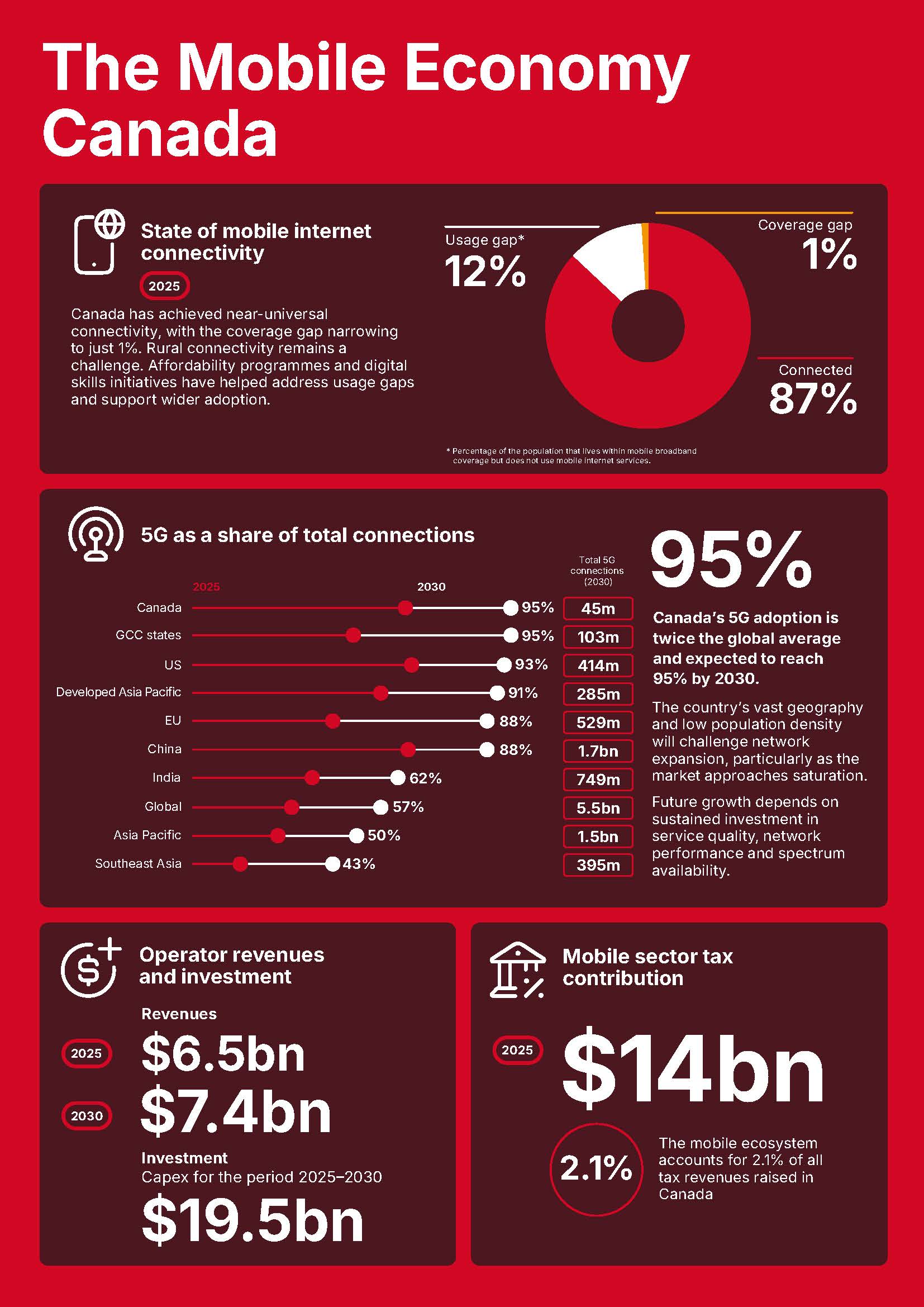
An infographic in the report highlights that 99% of Canadians live within mobile broadband coverage and 7/8 of us make use of that connectivity. Canada’s rate of 5G adoption is twice the global average.

But in my view, the kernel of the GSMA report isn’t found in looking at today’s release of a report based on yesterday’s numbers. As you might expect, I want to focus on tomorrow’s risks.

As I complain frequently, Canadian telecom policy has been dominated by affordability and competition objectives – important, but unfortunately short-sighted, with a populist, narrow focus. Eleven months ago, I wrote about a Liberal back-bencher rising in the House of Commons acknowledging the substantial drop in mobile prices being paid by consumers. “Canadians are paying lower prices for cellular services, with a 40% decline in prices over five years.” That wasn’t enough. She continued, “At a time when Canadians are concerned with rising costs and keeping their monthly bills affordable, can the Minister of Industry tell us how the government is working to lower cellphone bills?”

Industry Minister Joly proclaimed in response, “I, and this government, are laser-focused on making sure that we bring down costs in the telecom sector… We also said we would be hawkish on competition. We will do more in this budget to increase competition and make sure that we reform our telecommunications sector.”

GSMA argues that this framework was developed when mobile was a high-growth industry. Today, the market is more mature, revenue growth is slowing, and operators continue to face mounting obligations to fund 5G Standalone networks, AI infrastructure, cybersecurity, network resilience and future spectrum acquisitions.

The report advances a theme that my readers will recognize immediately: investment matters.

That theme echoes several discussions we’ve had over the past few years about the growing tension between consumer affordability and infrastructure investment. GSMA notes that Canada scores exceptionally well on wireless affordability while achieving mid-tier rankings on network performance measures, warning against policies that unintentionally undermine future investment incentives.

The 5G story is similarly nuanced. Canada has achieved more than 94% population coverage and reached one of the highest levels of 5G adoption globally, with nearly two-thirds of mobile connections already on 5G. Yet Canada ranks only 21st on the GSMA 5G Connectivity Index, highlighting a gap between broad coverage and leadership in advanced capabilities such as 5G Standalone, network slicing and enterprise applications.

Perhaps the most interesting section is found when the report focuses on AI.

GSMA sees telecom carriers becoming central players in Canada’s emerging sovereign AI ecosystem. Bell’s AI Fabric initiative, Telus’ Sovereign AI Factory, and operator investments in fibre, data centres and cloud infrastructure are presented as evidence that telecommunications networks are evolving from communications platforms into foundational AI infrastructure. At the same time, GSMA notes:

Canada faces structural constraints that could limit its AI ambitions. The most significant is the scale of its compute and data-centre infrastructure. As of September 2025, Canada had around 1.4 GW of operational datacentre capacity, versus more than 40 GW in the US.

Further, as I have written, AI cannot scale without connectivity. Every AI inference, every cloud workload and every edge computing application ultimately rides over robust communications networks. The GSMA report identifies mobile networks as a critical enabling layer for Canada’s AI ambitions.

The cybersecurity chapter is also worth reviewing. New legislation, mandatory outage reporting and growing concerns about infrastructure theft and cyberattacks are creating additional operational and financial pressures for operators. GSMA observes that resilience is more than an optional network enhancement. It is becoming a statutory obligation. How does this get funded in today’s regulatory and policy environment?

None of this means policymakers should abandon affordability objectives. Rather, the report serves as a reminder that affordability, network quality, digital sovereignty and economic growth are interconnected. Weak investment eventually translates into weaker networks, slower innovation and diminished competitiveness.

The GSMA report, The Mobile Economy Canada 2026, provides a reframing of telecommunications as something more than a consumer service. Wireless networks are a part of our national economic infrastructure, underpinning productivity, AI adoption, public safety and digital inclusion.

As Canada prepares for future releases of spectrum, AI investments, and eventually the transition toward 6G, a central question is whether the policy environment will create the investment climate necessary to sustain it.

The GSMA report can be viewed as a call for policymakers to shift from an affordability-first framework toward an improved balance of competition, consumer interests and long-term infrastructure investment – in short, a return to a more balanced approach for Canada’s telecom policy framework.

[Le rapport, “L’économie du mobile au Canada 2026”, est aussi disponible en français]

Building a stronger, more productive economy

Is sustained investment in telecommunications infrastructure essential to building a stronger, more productive economy in Canada?

That is one of the conclusions of a newly released PwC report commissioned by the Canadian Telecommunications Association. The Executive Summary of “Enabling Canada’s Economic Independence and Global Competitiveness Through Telecommunications” [pdf, 905KB] opens with:

Driven by substantial investments in network infrastructure, the telecommunications sector is a key enabler of the Canadian economy and instrumental in addressing Canada’s productivity challenge and building a stronger Canada. As geo-political challenges evolve, Canada faces mounting pressure on its economic independence and national security. By promoting sustained investment by telecoms in expansion and enhancement of network infrastructure, Canada should strategically leverage the telecommunications sector to safeguard Canada’s economic independence, and global competitiveness.

You have read my views many times on these pages, advocating for the government to maintain incentives for investment in digital infrastructure to power the next generation economy. PwC’s report helps quantify outcomes from such policies, while stating that ensuring the investment capacity of the telecommunications sector is a strategic imperative to maintain Canada’s economic independence.

PwC estimates the Canadian telecommunications sector contributed $87.3B in direct GDP, supported 661,000 jobs across various industries in 2024. Nearly two thirds of the direct GDP contribution arises from the increase in telecom connections. This drives improved productivity and business enablement across the entire economy. Between 2020 and 2024, PwC found that mobile connections grew at a compounded aggregate growth rate (CAGR) of 5%, while fixed internet connections grew at a rate of 2%. During that period, mobile service prices fell by more than 50%.

The report argues that we aren’t just talking about investments for faster, cheaper mobile internet connectivity; it’s a matter of “safeguarding national sovereignty, supporting secure digital commerce, and ensuring that Canadian businesses can compete globally through the adoption of the latest digital innovations that will improve productivity.”

As the report shows, Canada’s telecom companies, with a capital intensity ratio of 18%, face higher capital costs than global peers, such as the US, with a capital intensity of 14%, or Australia, at just 10%. Slowing revenue growth across the industry and an increasingly challenging regulatory environment are challenging the ability to make the investments needed to keep pace with demand.

Canada is grappling with a long-standing productivity challenge, as labour productivity has grown just 1% over the past eight years. The telecom sector, by contrast, has seen 12.4% productivity growth since 2017, thanks to its role in enabling smarter, more efficient operations across the economy.

PwC says “Canada’s ability to increase productivity and build a stronger, more competitive and resilient economy depends on expanding and continuing to enhance Canada’s high-quality telecommunications infrastructure.” According to the Canadian Telecommunications Association (CTA):

To secure Canada’s economic future, policymakers must treat telecommunications as a national strategic priority. This means creating a regulatory environment that encourages long-term investment, identifying regulations that are no longer necessary or whose costs outweigh the benefits, and recognizing telecom as a foundational enabler of productivity and national sovereignty.

In his address at The 2025 Canadian Telecom Summit, CTA president Robert Ghiz said “telecommunications is more than just a provider of consumer connectivity. It is more than phones and data plans. It is economic infrastructure — as vital to Canada as roads, railways, and ports.”

I couldn’t agree more. Strategically thinking, sustained investment in telecom infrastructure must be viewed as a foundational step toward building a stronger, more productive economy.

5G and Canada’s digital economy

In November, PwC released a series of reports on “The importance of 5G and the digital economy in Canada”:

  • 5G, the digital economy and Canada’s global competitiveness [pdf, 1.7MB]
  • The evolution of Canada’s telecom industry and the growing digital economy [pdf, 3.0MB]
  • The importance of 5G and the digital economy in Western Canada [pdf, 2.1MB]

As PwC notes, the past two years of life under the cloud of the COVID-19 pandemic have accelerated several trends associated with a transition to a new economic model, such as increasing demand for digital connectivity and greater adoption of digital processes by businesses and households.

PwC promotes the need to have a healthy domestic telecommunications sector to support the deployment of 5G, saying “jurisdictions where network operators were in poorer financial health had slower deployment and adoption rates.” PwC invites readers to read the first report for a discussion on the digital economy and implications on Canada’s global competitiveness associated with delays in 5G deployment. In that report, we read how the competitive landscape is being reshaped for mobile operators by hardware, software and service providers. PwC asserts that Canadian mobile network operators (MNOs) are “sub-scale relative to multinational digital economy players, whose business models are enabled by connectivity but do not invest in network infrastructure.” Further, PwC expects technological disruptions over the coming years from Low Earth Orbit satellites providing broadband internet, and the introduction of embedded SIM (eSIM) technology that “could be used by equipment manufacturers to disintermediate telecom operators.”

The second report makes four main points:

  1. The telecommunications industry is a core enabler of the digital economy;
  2. Canadian MNOs are relatively small compared to international peers, suppliers and new competition;
  3. Globally there is a trend of consolidation in the telecommunications industry; and,
  4. Canada needs to ensure its telecommunications industry can support the needs of the digital economy

Among the highlights, PWC observes that Canadian mobile operators spend a higher proportion of their revenue on capital investments than many peer countries. For example, the capital intensity (measured as a ratio of capital expenditure to revenue) for Canadian operators averages at 18%, five percentage points (or nearly 40%) higher than operators in the US and Australia at 13%.

The third report in the series zooms in on Western Canada looking at how 5G connectivity is expected to enable new “use cases”, such as automation enabling smart mining, connected and autonomous vehicles, and automated smart farming. “5G-enabled use cases require broad ubiquitous coverage to reach businesses outside urban areas (mining, agriculture, oil & gas, etc.) and enable use cases that are reliant on continuous connectivity (e.g., autonomous vehicles).”

According to PwC, Canadian mobile operators face three significant challenges: the cost of 5G driven by capital costs required to install new equipment, densify infrastructure and the
increased operational costs required to keep up with data use; Increased competition in the digital economy including hardware, software and service providers such as Google and Amazon; and, Canada’s current lag in spectrum allocations and the complexity of regulations for accessing passive infrastructure.

To deploy 5G at pace, and overcome these challenges, Canada will require a healthy telecommunications industry that has well-capitalized MNOs capable of funding national 5G deployment. To achieve this, Canada needs a supportive regulatory framework, that should: (i) maintain an appropriate level of market incentives, drive improved customer value and investment in innovation (ii) maintain predictable and fair regulations while being flexible to accommodate the evolving needs of the digital economy and (iii) consider the significant benefits of the digital economy, the role of 5G in enabling it, and the broader competitive landscape within it.

Canada requires a healthy, well-capitalized telecommunications industry to fund deployment of our national 5G networks.

A playbook for restarting Canada’s economy

At some point, we’re going to emerge from isolation and begin the normalization process for our lives and livelihoods.

When will that be?

When can that be? What kinds of key indicators will let us know that it is safe to relax certain restrictions?

What kinds of principles should guide us in understanding how to manage risks of viral transmissions? How (and when) do we begin to have government and industry collaborate to develop workplace standards and protocols to mitigate transmission risks?

Last Friday, the Crisis Working Group of the C.D. Howe Institute released an important report, “Canada Needs “Playbook” For Restarting Economy” [pdf, 167KB]. The Institute’s Working Group on Business Continuity and Trade (co-chaired by former Ontario Minister of Finance Dwight Duncan, and GE Canada VP Government Affairs and Policy Jeanette Patell) “discussed the need for a “playbook” to restart Canada’s economy, the implementation of supports for businesses to “bridge” the present shutdown, and the importance of continued investment in robust telecommunications infrastructure to meet the current surge in demand.”

While the focus of the discussion was an examination of the general economy, nearly a quarter of the report is dedicated to the telecommunications sector, recognizing “the important enabling role of Canada’s resilient telecommunications services during this crisis.”

The working group acknowledged the challenges facing telecommunications providers to maintain network reliability amid record usage levels when “every day is Superbowl Sunday.” Looking ahead, the roll-out of next generation networks will be essential for helping Canadians to adjust in a “new normal” (e.g., sustained “work from home”) for Canada’s economy post-crisis.
…
Members particularly emphasized that Canada’s telecommunications services have sustained economic activity as many Canadians switch to working by remote connection at home. The resilience of telecommunications networks today is a result of past investments and current efforts in the field to maintain infrastructure. Network providers are also rapidly building new facilities where these are needed – for example, to service remote learning for students and temporary medical facilities.

The report contains suggestions for measures governments could undertake to encourage further network resilience post-crisis, by providing incentives to accelerating capital investment by service providers. Referencing an report from a month ago [discussed in my blog post: “Could political interference create ‘sovereign risk’ for Canada’s digital infrastructure?”], the working group observed “government policies directed at reducing prices for telecommunications services (such as low rates for mandated access by resellers to telecommunications facilities) may discourage future investment.”

Looking ahead, the roll-out of next generation networks will likely be necessary in a “new normal” for Canada’s economy post-crisis. “Work from home” is likely to be sustained until the COVID-19 virus is fully contained. Fast and reliable telecommunications services will be essential for helping Canadians to adjust.

Recall, the group had previously stated, “If government pursues short-run political objectives at the expense of returns on long-lived infrastructure investments, certain Council members believe confidence in Canada’s regulatory regime for telecommunications will be difficult to win back.”

As a recent Intelligence Memo observed, “Recent experience demonstrates that, whatever discontents the federal government may be channeling, the quality and coverage of Canada’s networks, the cost of services, and the variety of platforms and carriers available, is impressive. Our telecommunications infrastructure is a vital asset. Good public policy should strengthen it.”

Building an innovation economy

Earlier this week, a new report was released by Startup Nation Central, an independent non-profit with a mission to connect business, government, and leaders from around the world with Israeli innovation. The report, “The State of Innovation: Operating model frameworks, findings and resources for multinationals innovating in Israel,” was compiled by PwC.

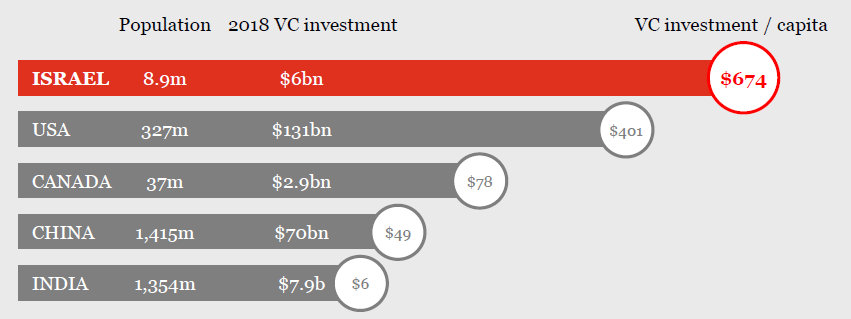
Israel’s innovation ecosystem is a model worth taking time to understand as economies seek to transform to be more knowledge based. There are more than 6,600 start-ups in Israel, 14 times the number of start-ups per capita in Europe. Despite having just 0.1% of the world’s population, in 2018 Israel attracted nearly 20% of global investment in cyber security. It ranks first in R&D expenditures as a percentage of GDP and the highest level of venture capital funding per capita; despite having less than a quarter of Canada’s population (8.9M versus 37M), Israeli firms secured just over double the level of VC investment (US$6B versus US$2.9B).

Why Israel? The report quotes the head of Microsoft’s Israel R&D centre crediting the country’s “population diversity, a bias toward actualizing ideas, and a global mindset focused on designing for export.”

How can Canada emulate Israel’s success? What can Canadians learn? How can companies benefit and help transform Canada’s economy?

Investing in an innovation agenda has been one of the key elements in the mandate handed to Minister Navdeep Bains when he was appointed in late 2015. Indeed, he oversaw the transition of his department from “Industry Canada” into Innovation, Science and Economic Development. Minister Bains will be the closing speaker at The 2019 Canadian Telecom Summit, being held June 3-5 at the International Centre in Toronto.

In addition, there will be panel looking at “The Innovation Economy: The Ongoing Journey to Digitize Our Lives” taking place on June 5, moderated by Namir Anani (CEO of the Information and Communications Technology Council of Canada).

Have you registered yet?

Scroll to Top